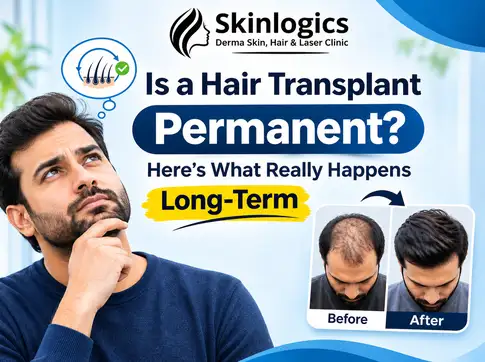
Is a Hair Transplant Permanent? Long-Term Results Explained
- Written by: Skinlogics Clinic Team
- Published: 19 Nov 2026
- Medically Reviewed by: Dr. Vandana Malik
- Last Reviewed: 19 Nov 2026
Is a hair transplant permanent? A hair transplant involves implanting healthy hair follicles from the back or sides of the scalp to the areas affected by hair thinning or baldness. The transplanted hair follicles are genetically, DHT-resistant so stays viable for many years. So, yes, transplanted hair usually keeps growing for many years, and even often for decades, because hair is taken from scalp areas that are less sensitive to the DHT hormone that is responsible for causing pattern baldness.
In this blog, understanding why transplanted hair tends to last, the factors affecting outcomes, when maintenance may be needed, and what results to really expect can help you make a confident decision. Explore more on this in this blog and for better insights you can consult with a hair transplant surgeon in Noida at Skinlogics.
How Does a Hair Transplant Work?
A hair transplant is a medical-cum-cosmetic procedure designed to restore hair in areas of hair thinning or balding using viable hair follicles from other sections of the scalp.
Follicular Unit Transplantation (FUT) or strip method is the oldest surgical technique. But nowadays, other techniques like Follicular Unit Extraction (FUE) and Direct Hair Implantation (DHI) are generally in more demand. Each approach varies slightly in how hair follicles are taken and relocated.
The technique chosen for hair transplant is based on what suits you depending on your donor hair, the area to be covered, your hairstyle and your surgeon’s assessment.
Why Transplanted Hair Usually Lasts?
Hair transplant grafts are typically harvested from the back or sides of the scalp, where hair is generally more resistant to balding. The donor areas are genetically less susceptible to the dihydrotes-tosterone (DHT) hormone. This hormone has a role in male and female pattern baldness. So, once the hair follicles with such genetically programmed resistance are transplanted to a new location, they retain their traits.
They establish new blood supply and thus stay well nourished to maintain a normal hair growth cycle. This is why a hair transplant is said to deliver long-term, often a lifetime of natural hair restoration.
What Is Permanent and What Isn't after Hair Transplant Surgery?
| Long Lasting | Results Can Change Overtime |
| Transplanted follicles extracted from roots | Patient non-transplanted hair may keep thinning overtime |
| Hair line designed during surgery | Overall hair density, as surrounding hair get affected with time |
| Hair growth cycle of the transplanted hair | Color of the hair, tend to change with age |
| One can cut, style and color the transplanted hair | Density of the donor hair affected with increasing age in some people |
Hair Transplant Results Timeline
Generally, the new, thick, and healthy hair growth takes several months, and by a year or more, the desired hair length, thickness, and coverage are achieved.
Here’s the usual recovery and results timeline of a hair transplant:
- Days 1-10: There will be slight redness and swelling at both donor and recipient areas, with the start of scabbing around the transplanted hair grafts.
- Weeks 2-8: The transplanted hair sheds naturally due to the shock of surgery, while its roots remain alive subcutaneously.
- Months 3-4: New hair starts to emerge and is usually thin and fine.
- Months 6-9: New hair becomes thicker and stronger. There is a considerable improvement in natural hair density or overall scalp hair coverage.
- Months 12-18: The desired results begin to appear. The new hair produced by transplanted hair follicles can be cut, washed, styled, or colored, just like normal hair, after complete recovery.
A hair transplant can provide long-lasting results, as transplanted hair often continues to grow for many years. But as previously mentioned, hair in non-transplant areas remains at risk of thinning and shedding, which is why follow-up treatments like minoxidil, finasteride, or PRP/GFC, along with occasional touch-ups, are clinically advised to maintain a head of healthy, natural hair over the long term.
Once healed, the transplanted hair can be washed, cut, styled, and coloured just like the rest of your hair.
Why Do Hair Transplants Fail? Or What Can Affect Long-Term Results?
Several factors influence the outcomes of hair transplantation and can create the impression of a failed hair transplant. These include:
- Age and Genetics
Hair transplant does not stop age- or genetics-related hair loss or thinning. The existing hair gradually thins and falls out at a rate determined by the pattern of hair loss in the family. Thus, patients see new areas of hair loss years later.
- Poor Surgical Planning
When a hair transplant is planned and performed by a surgeon who is not skilled or experienced in it, there is a high chance of:
- Creation of an unnatural-looking hairline
- Selection of poor-quality donor hair
- Less survival of transplanted hair grafts
- Uneven hair density.
- Inadequate Post-Hair Transplant Care
The aftercare plan plays a major role in the results obtained after a hair transplant. Poor wound care, poor scalp and hair hygiene, smoking habit, unhealthy diet, excessive stress, missed follow-ups, or not adhering to the surgeon’s post-operative care instructions can affect graft survival, healing, and overall outcomes and their sustenance.
Do You Need Medicines After a Hair Transplant?
Even though the transplanted hair is genetically programmed to grow normal hair in the long term, the earlier tried or used hair growth promoting medications like minoxidil, finasteride (for selected male patients), or dutasteride (for some patients) or therapies like PRP (Platelet Rich Plasma) or LLLT (Low-Level Laser Therapy) are still recommended to be consistently used to preserve natural, healthy hair growth.
Such treatments can help delay ongoing hair loss and maintain the required healthy scalp coverage.
Will There Ever Be a Need for Another Hair Transplant?
A second hair transplant or revision is usually not needed. It is only considered when:
- Earlier non-transplanted areas show advanced hair thinning or baldness.
- Previous hair transplant surgery could not address all affected areas of hair thinning or loss.
- The first hair transplant was intentionally conservative.
- When proper aftercare and supportive hair growth-promoting treatments were not followed after the first hair transplant surgery.
Final Thoughts
Hair transplantation helps restore naturally lost hair in the long term. The hair grafts selected from the back or sides of the head and implanted into hair-thinning or balding areas are genetically resistant to miniaturization and permanent fall-out. However, the hair transplant process has nothing to do with further hair thinning or hair loss in unoperated areas.
When an expert performs a hair transplant, an experienced surgeon using a suitable technique, followed by appropriate medical therapy and an aftercare plan, a head full of healthy hair can last in the long term.
To find out whether a hair transplant suits you, you can consult a dermatologist or hair transplant surgeon at Skinlogics, Noida.
Frequently Asked Questions on Hair Transplant
Can transplanted hair fall out?
Shedding of transplanted hair is natural within a few weeks after a hair transplant. But when new hair grows, they fall and grow just like normal hair. Permanent loss of well-established transplanted hair grafts is uncommon, possible only with certain medical issues, trauma, or scarring disorders.
What is the right age for a hair transplant?
There is no fixed age, but surgeons are cautious with patients under 25. At this age, the pattern of hair loss may not be clear. The surgeon considers your age, family history, and severity of hair loss before recommending the procedure.
Can transplanted hair become grey?
Yes. Transplanted hair can also turn grey with age, just like the hair that naturally grows on the scalp.
How long do hair transplant outcomes last?
In most cases, the transplanted hair initially falls and then grows back with a normal hair growth cycle for decades. With appropriate additional procedures, proper aftercare, and regular follow-ups, the desired results of a hair transplant last longer.
Clinic Details
Skinlogics Clinic
Address: D-82A, opposite Ambedkar Hospital & Police Chowki, near by Jaipuria Plaza, D-Block, Sector 26, Noida, Uttar Pradesh 201301
Phone / WhatsApp: [09999172667 ]
Timings: Mon - Sun : 9AM - 8PM
[https://share.google/FJxoKcrKaiizNcT8f]
Disclaimer: This article is for general information and does not replace a consultation with a qualified doctor. Suitability, results and side effects vary from person to person, and no specific outcome is guaranteed.